AI notetakers beyond transcription: How leading companies turn meetings into measurable business value
Transform meetings into measurable business value. Learn how top companies use AI notetakers for 15% higher win rates, automated workflows & strategic insights beyond basic transcription.



Meetings generate massive amounts of data—but most of it dies in the digital graveyard of forgotten recordings and unread transcripts. The paradigm's shifting though. According to AssemblyAI's 2025 State of Conversation Intelligence Report, conversation intelligence has crossed the threshold from experimental to standard practice. The market's responding accordingly, with projections reaching $46.8B by 2033.
Here's the thing: basic transcription is now table stakes. The real competitive advantage? Companies that build systems to transform conversations into automated workflows, strategic insights, and measurable business outcomes.
The AI notetaker market: A value creation framework
AI notetakers create value beyond transcription through three distinct capabilities: automated workflow integration, performance analytics, and strategic business intelligence. These tiers build progressively—basic transcription enables CRM automation, which powers coaching insights, which drives revenue forecasting among conversation intelligence platforms.
Each tier represents a fundamental shift in how organizations extract value from conversations. Tier 1 saves time. Tier 2 improves performance. Tier 3 drives strategy.
But here's what most people miss: Tier 3 capabilities require foundational excellence. You can't build strategic intelligence on shaky transcription. Accuracy, reliability, and customization at the foundation determine how high you can build.
The companies that win with AI notetakers? They leverage Tier 2 and 3 capabilities to create measurable business impact—and that's what we'll explore.
Core Voice AI capabilities that drive business outcomes
AI notetakers transform meetings into business value through three foundational technologies: accurate speech recognition, advanced speech understanding models, and scalable infrastructure. Each component plays a critical role in delivering measurable results.
Accurate speech-to-text and speaker diarization
The entire value chain of an AI notetaker begins with accurate transcription. If the transcription is wrong, every downstream insight fails—summaries, sentiment analysis, and business intelligence become unreliable.
High-accuracy speech-to-text directly impacts business outcomes:
- Fewer manual corrections and editing time
- Reliable workflow automation
- Better decision-making from trustworthy data
Speaker diarization proves equally critical—knowing who said what enables action item attribution, talk-to-listen analysis, and individual coaching. Modern systems handle overlapping speech across multiple participants, extracting insights from complex meetings.
Advanced speech understanding models
Advanced speech understanding transforms transcripts into structured business data through multiple AI capabilities:
- AI summarization: Distills hour-long meetings into essential points
- Sentiment analysis: Flags at-risk deals and customer satisfaction changes
- Topic detection: Automatically categorizes discussions by themes
- Entity Detection: Identifies competitors, products, and compliance terms
This creates a queryable business intelligence database. Sales teams find competitor mentions instantly, product teams track feature requests in real-time, and customer success identifies churn signals proactively.
Scalable and reliable API infrastructure
The most powerful AI models deliver no value if they can't integrate reliably into existing workflows. For companies building AI notetakers, robust infrastructure determines whether their solution becomes mission-critical or remains experimental.
Enterprise-grade platforms process millions of hours of audio without outages, deliver results with minimal latency, and provide the flexibility to build custom workflows. This infrastructure enables real-time applications like live meeting assistance and scales to support organizations from startups to Fortune 500 companies.
Companies like Clari, CallSource, and Jiminny rely on this foundation to power their conversation intelligence platforms. Infrastructure reliability directly impacts their customer experience and business outcomes.
Quantified business impact: Real ROI metrics
Sales performance transformation
The numbers tell a compelling story. Jiminny customers achieve 15% higher win rates while increasing customer satisfaction by at least 51%. That's not incremental improvement—it's transformation.
Individual contributors see even more dramatic results. Sales reps who spend just 3-4 hours per month reviewing their calls improve win rates by 5.5% (Jiminny, 2024). Think about that ROI: four hours of listening for a 5.5% performance boost.
These improvements come from automated deal intelligence that surfaces risks before they derail opportunities. Modern AI notetakers analyze conversation patterns, flag missing qualification criteria, and alert managers to deals that need attention. It's like having a sales coach listening to every call—except it scales infinitely.
Forecast accuracy improves dramatically too. When every customer interaction feeds into your intelligence system, pipeline predictions move from educated guesses to data-driven forecasts. Sales leaders report 30% improvements in forecast accuracy after implementing conversation intelligence.
Operational efficiency and team development
The time savings alone justify the investment. Teams of 10 people collectively recover 200+ hours monthly of productive time. That's five extra work weeks per month across the team.
But time recovery is just the beginning. Automated workflows save 4+ hours per week per person by handling note-taking, follow-up emails, and CRM updates (Avoma platform data). Multiply that across your organization—the productivity gains compound quickly.
Coaching transforms too. Instead of managers randomly sampling calls, AI scores every conversation against your playbook. New reps learn faster by accessing libraries of successful calls; veterans identify blind spots they didn't know existed. Organizations with AI-powered coaching programs see 28% higher win rates.
Market intelligence and strategic insights
Here's where things get really interesting. AI notetakers become your always-on market research team. They track competitor mentions across thousands of conversations, identifying trends before they show up in quarterly reports.
Product teams get unfiltered customer feedback at scale. Instead of relying on surveys or second-hand reports, they analyze actual customer conversations. Feature requests, pain points, and use cases emerge organically from the data.
One SaaS company discovered through conversation analysis that enterprise customers mentioned "compliance" 3x more often in the past quarter. They pivoted their roadmap, launched compliance features, and captured a new market segment—all because their AI notetaker surfaced the trend.
Advanced features that create value
Intelligent CRM automation and workflow integration
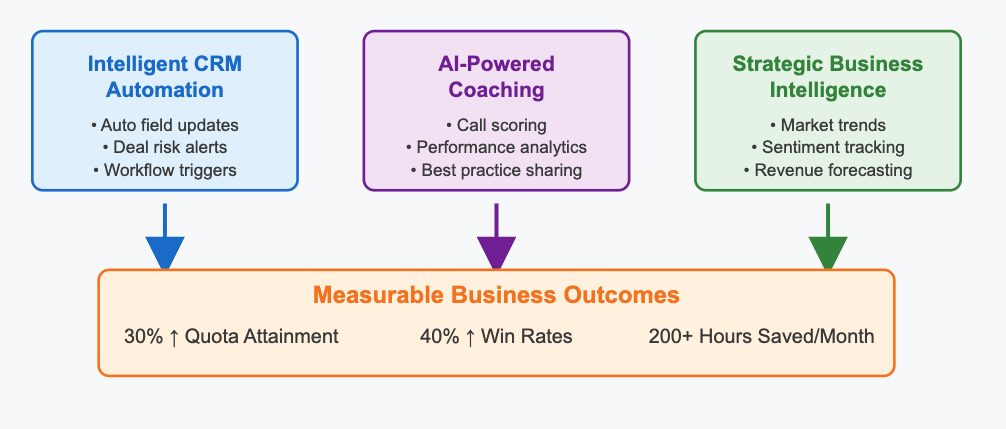
Forget basic call logging. Modern enterprise conversation intelligence platforms automate custom CRM field updates for methodologies like MEDDIC, SPICED, and BANT. They populate deal stages, update contact roles, and trigger workflows—all without manual intervention.
Real-time deal risk assessment changes the game. AI analyzes conversation sentiment analysis, identifies missing stakeholders, and flags deals showing signs of stalling. Companies using these Speech Understanding systems increase quota attainment by 30% through early intervention (Avoma, 2025).
Workflow automation extends beyond CRM. AI notetakers trigger Slack alerts for competitive mentions, create Jira tickets for feature requests, and update project management tools with action items. Organizations are moving beyond basic transcription—they're building conversation-driven workflows that span their entire tech stack.
AI-powered coaching and performance analytics
Automated coaching scales what was previously impossible. AI scores calls against your specific playbook—whether that's Sandler, Challenger, or your proprietary methodology. It tracks talk-to-listen ratios, question frequency, and objection handling in real-time.
The impact? Teams reduce ramp time and increase win rates by 40% with automated call scoring and personalized coaching. New reps get instant feedback; experienced reps discover patterns in their lost deals.
Best practice replication becomes systematic. High performers' techniques get identified, codified, and taught automatically. One sales leader described it as "turning rookies into veterans in half the time."
But it goes deeper. Conversation intelligence reveals the "why" behind performance differences. Maybe top performers ask twice as many discovery questions. Maybe they mention pricing later in conversations. AI surfaces these insights automatically.
Strategic business intelligence and market analytics
AI notetakers have become strategic enablers rather than passive documentation tools. They track competitor mentions, pricing discussions, and feature requests across every customer touchpoint.
Customer sentiment analysis provides early warning systems. Declining sentiment scores trigger retention workflows before customers churn; rising sentiment identifies expansion opportunities.
Revenue teams use conversation quality metrics for forecasting. Deal velocity, stakeholder engagement, and technical discussion depth all correlate with close rates. AI notetakers quantify these factors, turning gut feelings into data-driven predictions.
Industry-specific applications: How leading companies deploy AI notetakers
The true power of AI notetakers emerges when they're adapted to solve specific industry challenges. Across sectors, companies are moving beyond generic productivity gains to build specialized, high-impact applications that transform how their industries operate.
Sales and revenue intelligence
Sales teams treat every conversation as strategic data. Companies like Clari and CallSource analyze calls to provide real-time coaching and score deals against proven methodologies.
These platforms track key performance indicators automatically:
- Talk patterns and question frequency
- Competitor mentions and objection handling
- Deal progression and risk factors
Sales leaders replicate top performer behaviors systematically and intervene before deals stall.
Customer support and contact centers
In contact centers, AI notetakers are revolutionizing quality assurance and agent training. Instead of manually reviewing a random sample of calls, platforms analyze every customer interaction to ensure consistent service quality and identify coaching opportunities.
Companies like Workiz and Dialpad use this technology to reduce agent ramp time significantly, ensure script adherence at scale, and identify the root causes of customer issues. When you analyze all conversations instead of just a small sample, patterns emerge that would otherwise remain hidden.
The technology also enables proactive customer service. By analyzing sentiment trends across support interactions, companies identify product issues before they become widespread, predict churn risk, and automatically escalate critical issues.
Healthcare and clinical documentation
Healthcare faces a unique challenge: clinician burnout driven largely by documentation burden. AI notetakers are helping solve this crisis by automatically documenting patient encounters, allowing doctors to focus on care instead of keyboards.
Companies like PatientNotes.app and Medcorder have built specialized solutions that understand medical terminology, comply with healthcare regulations, and integrate with electronic health record systems. These platforms don't just transcribe—they structure clinical information in formats that meet documentation requirements while preserving the nuance of patient interactions.
The impact extends beyond time savings. When clinicians can maintain eye contact instead of typing, patient satisfaction improves. When documentation happens automatically and accurately, billing accuracy increases and compliance risks decrease.
Legal and compliance
Legal teams use AI notetakers to transform how they handle depositions, client meetings, and internal discussions. Accurate transcription with speaker identification creates searchable records of all legal proceedings, making case preparation more efficient and thorough.
Compliance teams leverage the technology to monitor regulated communications, automatically flag potential violations, and maintain audit trails of all relevant conversations. When every interaction is documented and analyzed, organizations demonstrate compliance proactively rather than scrambling during audits.
Implementation strategies and integration best practices
Success with AI notetakers requires strategic thinking about build versus buy decisions, integration approaches, and long-term innovation partnerships. The most successful implementations follow proven patterns that maximize value while minimizing risk.
Build vs. buy: Focusing on your core differentiator
The decision of whether to build Voice AI capabilities in-house or partner with a specialized provider fundamentally shapes your AI notetaker strategy. Building competitive speech-to-text models from scratch requires massive investment in research, data collection, and specialized engineering talent—resources that could otherwise focus on your unique value proposition.
Consider the requirements: training data across thousands of hours of audio, ongoing model improvements to maintain accuracy, infrastructure to process audio at scale, and expertise in the latest AI research. Companies that attempt to build everything in-house often find themselves years behind specialized providers and distracted from their core business.
The most successful AI notetaker companies focus their resources on creating exceptional user experiences and industry-specific applications while partnering with Voice AI platforms for foundational capabilities. This approach allows them to launch faster, maintain competitive accuracy, and benefit from ongoing improvements without the overhead of a full AI research team.
Integrating with your existing tech stack
An AI notetaker shouldn't exist in isolation—its value multiplies when deeply integrated with your existing systems. Modern platforms enable sophisticated integrations that transform conversations into automated workflows across your entire tech stack.
Successful integration requires thoughtful API design that handles authentication securely, processes data efficiently, and maintains reliability even at high volumes. The best platforms provide SDKs and documentation that make integration straightforward for your development team.
Choosing a partner for long-term innovation
Voice AI technology advances rapidly. Models that were state-of-the-art last year may be outdated today. When selecting a Voice AI partner for your AI notetaker, evaluate their commitment to ongoing research and innovation.
Look for partners who consistently release improved models with better accuracy, expanded language support, and new capabilities. Review their track record of innovation—do they lead or follow industry trends? Assess their infrastructure reliability and ability to scale with your growth.
The right partner becomes an extension of your team, providing not just technology but expertise and guidance as you build and scale your AI notetaker. They should understand your industry's unique challenges and help you navigate technical decisions that impact your long-term success.
Building strategic advantage with Voice AI-powered insights
AI notetakers have evolved from productivity tools into critical infrastructure for data-driven decision-making. Market leaders build competitive advantages through systematic conversation analysis.
Winning companies share key characteristics:
- Accuracy focus: Treating transcription quality as non-negotiable
- Deep integration: Building intelligence into core workflows
- Measurable outcomes: Tracking conversation insights to business results
- Strategic partnerships: Choosing providers who enable long-term growth
Every customer interaction becomes a data point that contributes to organizational learning and competitive advantage.
But here's what separates leaders from laggards: the foundation. Without world-class speech recognition accuracy, sophisticated speech understanding capabilities, and reliable infrastructure, any attempt to build strategic intelligence will fail. The best products have to be built on the best models.
The future belongs to organizations that recognize conversations as their most underutilized data source. Those who act now, building systematic approaches to capture, analyze, and act on conversation intelligence, will define their industries' next chapter.
Ready to transform your meetings into measurable business value? The technology exists. The playbooks are proven. Try our API for free and discover how AssemblyAI's Voice AI models can power your next-generation AI notetaker.
Frequently asked questions about AI notetaker implementation and ROI
Are AI notetakers safe and legally compliant?
Yes, enterprise-grade AI notetakers comply with recording consent laws and implement SOC 2 Type 2 security with end-to-end encryption. Leading providers offer healthcare BAAs and GDPR compliance for regulated industries.
What's the real ROI of an AI notetaker?
AI notetakers deliver ROI through productivity gains (4+ hours saved weekly), performance improvements (15-40% higher win rates), and strategic insights from conversation analysis. Organizations see compound returns when every conversation contributes to systematic coaching and competitive intelligence.
How do you choose the right Voice AI model for an AI notetaker?
Evaluate accuracy across real-world audio conditions, ensure comprehensive speech understanding capabilities through a unified API, and assess documentation quality and developer support. Look for providers with proven success in similar use cases and strong technical expertise.
What's the difference between basic transcription and conversation intelligence?
Basic transcription captures "what" was said while conversation intelligence analyzes "so what" and "now what"—extracting sentiment, coaching opportunities, and triggering automated workflows. It's the difference between passive documentation and active business intelligence that drives measurable ROI.
Lorem ipsum dolor sit amet, consectetur adipiscing elit, sed do eiusmod tempor incididunt ut labore et dolore magna aliqua. Ut enim ad minim veniam, quis nostrud exercitation ullamco laboris nisi ut aliquip ex ea commodo consequat. Duis aute irure dolor in reprehenderit in voluptate velit esse cillum dolore eu fugiat nulla pariatur.
Related posts